The Dust
The DispossessedThe Dust is the arid interior of Southwest Anarres: once forested, it has been transformed by prolonged drought into a region of fine grey soil, exposed hills, and scattered mining towns. It is both a landscape under attempted repair and a measure of the limits of Anarres’s solidarity, as ecological scarcity eventually reaches the systems that move food and assign labor.
Geography and ecological history
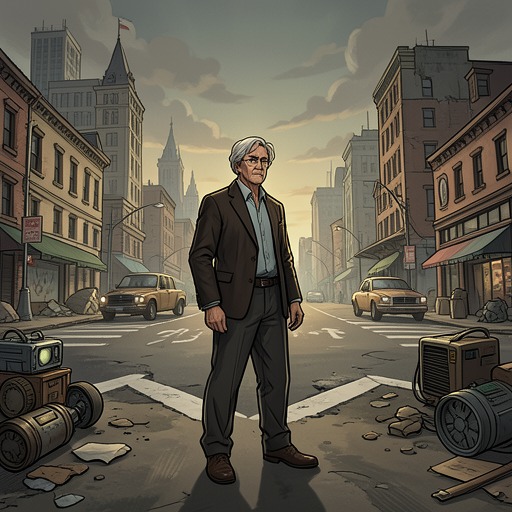
The Dust occupies the broad interior west of the fertile coastal strip in Southeast Anarres. The region is largely uninhabited apart from isolated mining towns. In an earlier geological era, it was covered by holums, the planet’s dominant and widespread plant genus. A hotter, drier climate and millennia of drought killed the trees and dried the soil to fine grey dust, which the wind lifts into barren, dune-like hills.
The damage is not merely a backdrop to human activity: dust burdens people’s bodies and work, while the condition of the land sets the terms of their hopes. At the afforestation camps, workers cough as fine dust clogs their throats and lungs. The same substance is at once their enemy, their responsibility, and the ground on which they hope to rebuild fertility.
The afforestation project
During the fifteenth decade of the Settlement of Anarres, the afforestation of the West Temaenian Littoral became one of the settlement’s major undertakings, employing nearly eighteen thousand people over two years. The project aimed to restore the Dust by replanting the forest that had once held its soil and supported its fertility.
Shevek is assigned to the project as a young worker. Though the planting work gives the restoration effort an immediate, collective purpose, he longs to return to physics and believes he has not yet learned enough to write about the relation between Odo’s ideas and temporal theory. The Dust therefore marks a conflict between the work urgently required by the community and the intellectual work he wants to pursue.
In the project’s second year, trucks bring thousands of seedlings raised in the Green Mountains, where rainfall is abundant, and planting crews set them into the dry ground. When the fifty crews finish and drive away, they look back at a faint mist of green across the pale desert. Their cheering and singing register a visible, if still slight, change: a veil of new life lies over land shaped by long ecological decline.
Scarcity and social consequences
The Dust’s dryness is connected to risks that extend far beyond the planting camps. During a later drought, Southrising’s leaf crops fail after thirty decads without rain. Talk of modern desalination plants offers only qualified hope: they might alleviate the crisis, not prevent it. Winter arrives early, cold, and dry; water is directed toward keeping crops alive, while bath water is strictly rationed. Food and clothing for Anarres’s twenty million people depend on holum plants, and the society has little reserve food.
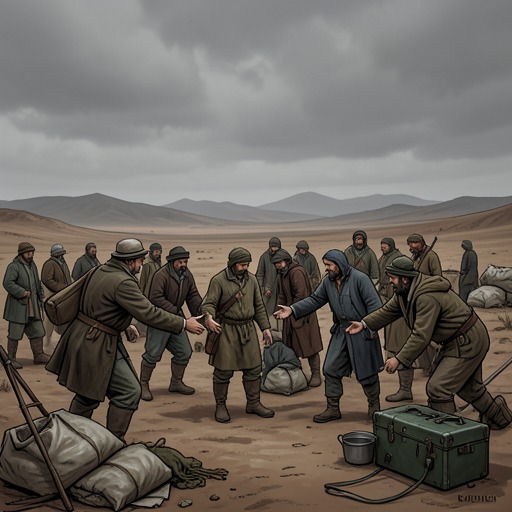
The crisis exposes how ecological hardship travels through infrastructure and distribution. After a year of drought, the transport network cannot meet demands for provisions and emergency labor shifts. A train carrying Shevek stops for twenty hours after a dispatch error and a wreck. The mill town where it waits has no surplus food; sharing with the train’s 450 passengers could leave its 160 residents without food for days. The townspeople give the travelers nothing, who then fast for sixty hours before reaching a station with provisions. Shevek’s experience makes hunger, previously outside his experience, a test of whether solidarity can endure when there is not enough to share.
A worker’s account of rationing at Elbow shows another consequence of scarcity: people who were too sick or weak to work could be placed on half rations, yet those rations might keep them alive without enabling them to recover and return to work. The worklister who made those decisions quit, but someone else took over the lists. The Dust’s history of ecological loss thus resonates with the novel’s later questions about how shortages, transport, and labor rules distribute risk—and whether a society founded on mutual aid can preserve that ethic under pressure.